




About Mr Peter Chin
Peter Chin MBBS (Melb) FRACS is a Specialist Oncoplastic Breast and General Surgeon for Tauranga and the wider Bay of Plenty region. He specializes in oncoplastic breast cancer surgery and has a strong interest in laparoscopic (keyhole) hernia and gallbladder surgery, thyroid, melanoma and sentinel node procedures. He is highly skilled in advanced general surgery and is referred complex cases from throughout the region.
Peter is the Bay of Plenty’s most experienced breast surgeon and has performed over 2,000 breast cancer operations since 2006. He is a leader in his field and his experience and caring nature ensures that you will be given the best and most comprehensive advice possible.
Peter is a graduate of the University of Melbourne Medical School and undertook his surgical training in New Zealand. Upon completion of his Fellowship with the Royal Australasian College of Surgeons (FRACS), he spent 2 years of post-fellowship specialty training in the United Kingdom, firstly at the Royal Devon & Exeter Hospital and thereafter at the internationally-renowned Edinburgh Breast Unit. Upon completion of his subspecialty training, Peter returned to New Zealand in 2006 to take up his post as a specialist breast and general surgeon in Tauranga Hospital. He has also been in private practice since 2007, operating at the Grace Private Hospital.
Peter plays an active role as a consultant surgeon within the Surgical department at Tauranga Hospital and has regular weekly operating lists for which he performs a wide range of general surgical procedures. He takes part in the weekly acute surgical roster, providing expertise in treating acute surgical conditions and trauma management. Peter is a Fellow of the Royal Australasian College of Surgeons (RACS), a member of the NZ Association of General Surgeons, an enthusiastic surgical teacher for advanced surgical trainees and the supervisor of trainee interns in General Surgery at Tauranga Hospital.
Languages Spoken
English, Cantonese, Malay
Disability Access
Services
Special Interests
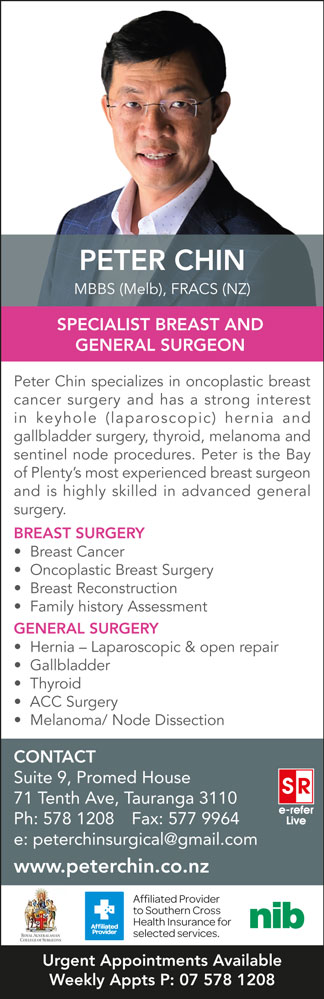
Peter Chin specializes in oncoplastic breast cancer surgery and has a strong interest in keyhole (laparoscopic) hernia and gallbladder surgery, thyroid, melanoma and sentinel node procedures. Peter is the Bay of Plentys most experienced breast surgeon and is highly skilled in advanced general surgery.
Areas of Specialisation
BREAST SURGERY
- Breast Cancer
- Oncoplastic Breast Surgery
- Breast Reconstruction
- Family history Assessment
GENERAL SURGERY
- Hernia - Laparoscopic & open repair
- Gallbladder
- Thyroid
- ACC Surgery
- Melanoma/ Node Dissection
Laparoscopic cholecystectomy, Open repair of inguinal hernia, Open repair of umbilical hernia
Credentials
Qualifications
MBBS (Melb), FRACS (NZ)
Memberships
Royal Australasian College of Surgeons (RACS)
NZ Association of General Surgeons (NZAGS)
Foundation Member, Breast Surgeons of ANZ
Australasian Society of Breast Diseases (ASBD)
Melanoma Foundation of NZ
Hospitals Practising at
Grace Hosp, Tauranga (Pvt), Tauranga Hosp (Public)
Gallery
Contact Mr Peter Chin
Weekly Appts P: 07 578 1208